
From ATTUNE to CREATE: Reflections on youth voice and system change
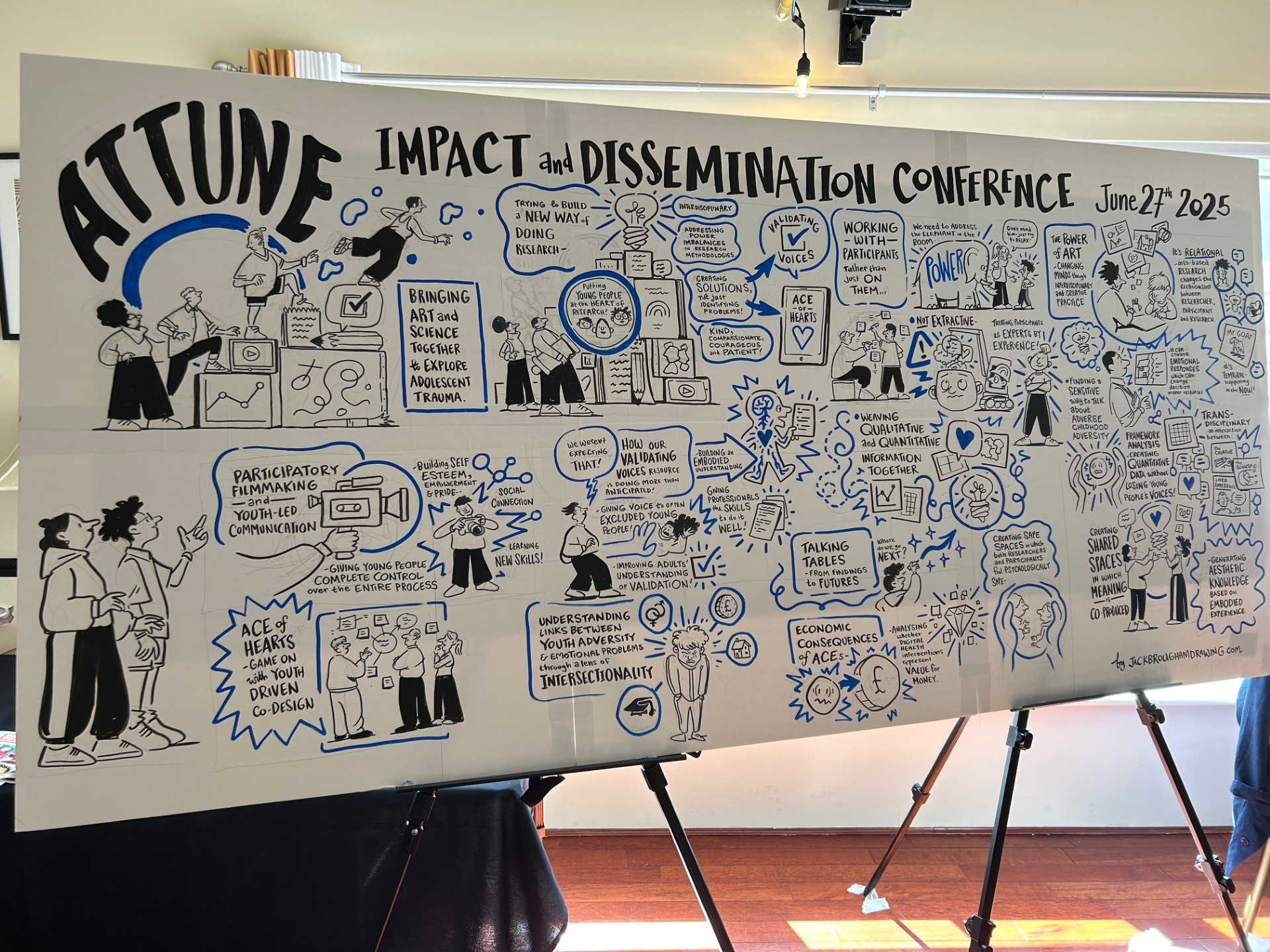
Professor Paul Cooke, Principal Investigator on Project CREATE, shares key lessons from the final ATTUNE conference and his hope that they will shape ongoing and future research in youth mental health and participatory work. In this work and Project CREATE, listening and inclusion of youth voices remain central, a message powerfully captured by a cartoonist who illustrated the conference live (Jack Brougham).

Professor Paul Cooke is Principal Investigator on Project CREATE.
I’ve just spent an inspiring day at the final ATTUNE conference: “Bringing Science and Art Together to Explore Adolescent Trauma” (June 2025). ATTUNE is participatory arts-based exploration of young people's mental health following adverse childhood experiences (ACEs). It is the project that inspired Project CREATE, and its influence has been invaluable.
Most importantly for me, this final event was curated by one of our Young Persons’ Advisory Board (YPAG) members, Srhya Lalh, alongside Jack Hanrahan, who, while not officially part of Project CREATE, has been part of the conversation at various events.
Being there left me with some reflections on what truly matters for Project CREATE and how we can keep moving forward.
- Youth voice: more than listening
The role of youth voice was a central theme throughout the day. There was plenty of discussion about needing to "listen to young people’ and ‘respecting their opinion’, which is clearly fundamental. But what I thought was particularly interesting was that this was generally a given. It was the starting point, and the real conversation was about what listening actually means in practice.
Participants reflected of the implications of listening, and crucially, not listening to young people in the kind of work were collectively doing in Project CREATE. Listening but not hearing young people was seen as more damaging than not listening at all.
Young people have a lot going on in their lives, and their decision to engage (or not) is not about interest or commitment
- Invitation, not expectation

Some of our young people involved in a filmmaking Living Lab.
One of Project CREATE’s core values is that every opportunity is an invitation rather than an expectation. It was considered to be a very important part of the project underpinning the quality of engagement that the young people are able to give to the project.
Young people have a lot going on in their lives, and their decision to engage (or not) is not about interest or commitment. It can simply be about their time available. We have to ‘decentralise’ engaging in young people’s advisory boards as a way of judging the importance that a young person might want to give to a project.
- Youth-led films as powerful critique
The films made by young people on ATTUNE were another real highlight. It was a five-year project, and the early films were great, but the final pieces were extraordinary. Not only were they technically excellent, but they also offered a critique of the project that would stand up against any more ‘formal’ evaluation of the project that the team might commission.
The ATTUNE youth film crew were indeed tasked with making films that both captured what was happening across the project and critiqued it at the same time.
- Participatory filmmaking as an activist tool
Finally, this conference reinforced my passion for using participatory filmmaking as an activist tool to amplify the voices of young people. I was concerned by the way some projects tend to seek to ‘medicalise’ this. While participants might get involved in a project because they have something to say about ‘Adverse Childhood Experiences’ or ‘Adolescent Loneliness’, their engagement is based on how participation has made them feel better about themselves.

Professor Siobhan Hugh-Jones (left) at one of Project CREATE’s Living Labs.
The research led by University of Leeds Professor Siobhan Hugh-Jones, who is also a Co-Investigator on Project CREATE, and her ATTUNE team has produced the best work I’ve ever come across. It understands the therapeutic potential of arts-based interventions for adolescent mental health while ALSO maintaining the centrality of the activist/advocacy impulse.
This work powerfully addresses the issue of epistemic justice (systemic justice), highlighting how young people are often not listened to by the very services meant to support them.
Changing the system and supporting wellbeing
This is exactly what Project CREATE is about: working alongside young people to ensure their voices aren’t just heard, but embedded into the systems that shape their lives. It’s about changing the system and supporting wellbeing, in that order.
This important work has only just begun, but I really hope we can find ways to build on it together, even beyond Project CREATE which officially comes to an end in October 2025.