
Four Years of CREATE: What I’ve Learned Along the Way

by Prof. Paul Cooke
They showed how the arts can open up entirely new ways of thinking about and exploring mental health, approaches far more inventive, nuanced, and meaningful than I could have imagined at the outset.
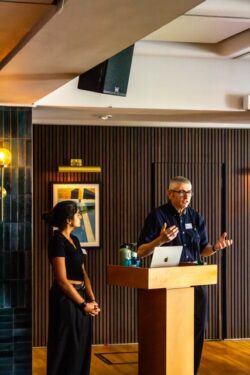
Paul Cooke at the CREATE in Full conference
CREATE has been a huge part of my life over the last four years. What began as a funding application gradually grew into something much bigger than I had imagined: a vibrant, collaborative community. Through it, I’ve met an extraordinary mix of people: academics from across the UK spanning a wide range of disciplines, professionals working at the intersection of research and practice, and, most importantly, a diverse and hugely talented group of young people.
Those young people brought something invaluable to the project: their lived experience and their creativity. They showed how the arts can open up entirely new ways of thinking about and exploring mental health, approaches far more inventive, nuanced, and meaningful than I could have imagined at the outset.
Why I Got Involved
My motivation for joining CREATE stemmed from a longstanding concern. I had noticed the widespread use of the term “therapeutic” in participatory arts projects, often without any clear grounding in existing research or the involvement of people with therapeutic expertise. There seemed to be an underlying assumption that “doing art” was inherently good for mental health, but rarely was there a clear explanation of how, why, or even what kind of “good” was being referred to.
Projects like this involve multiple stakeholders, researchers, practitioners, young people, organisations, and CREATE allowed us to experiment with ways of bringing those groups together more equitably
CREATE gave me an opportunity to interrogate that assumption properly. Working alongside colleagues in Psychology, we began to explore in depth the idea of the therapeutic affordances of different art forms. What do different practices offer? Under what conditions? For whom?
Crucially, we also wanted to think about how this work is done. Projects like this involve multiple stakeholders, researchers, practitioners, young people, organisations, and CREATE allowed us to experiment with ways of bringing those groups together more equitably, ensuring that what emerged was genuinely useful and meaningful for everyone involved.
What We’ve Built
Four years later, through an iterative process of “learning by doing” (something we describe in more detail elsewhere through our Living Labs methodology), CREATE has generated a substantial body of resources.
Now the challenge is different. It’s no longer just about creating knowledge, but about ensuring that these resources are actually taken up and used, by researchers, practitioners, and communities, to make the most of arts-based approaches in adolescent mental health.
A Persistent Challenge
One issue that has consistently stood out to me is how rarely the art itself, the creative outputs produced through these projects, is truly engaged with in research findings.
In a review we conducted for CREATE, we screened 7,281 arts-based mental health studies involving young people. Of those, only 161 made any meaningful attempt to engage directly with the artistic outputs themselves.
Why is this the case? One key reason we identified was a lack of confidence. Researchers who are more comfortable analysing spreadsheets or interview transcripts often feel unsure about how to “read” a piece of art,how to interpret it, respond to it, or draw insights from it in a rigorous and respectful way.
Introducing RESPOND
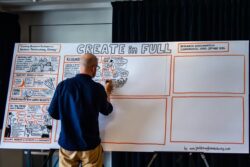
Jack Brougham illustrator capturing the CREATE in Full conference.
To address this, we developed the RESPOND framework, led by Professor Nickie Shaughnessy (University of Kent). It provides a structured way of engaging with artistic outputs, helping researchers, practitioners, and others to draw out insights without losing the richness and integrity of the work.
And so, to close this post, I want to use RESPOND to reflect on the CREATE in Full cartoon produced live at our final conference by the hugely talented artist Jack Brougham.
The RESPOND Framework
React: The first thing I notice about this cartoon is its density and its pull. It’s rich in detail, and immediately my eye is drawn from frame to frame as I try to take it all in. There’s a sense that the activity within these panels is almost too big to be contained by them; it wants to spill out. If I had to summarise the overall feeling in a single word, it would be energy.

RESPOND Framework flyer
Engage: Looking more closely, that sense of energy starts to feel like more than just an impression, it becomes a structuring force. The cartoon seems to be getting “under the hood” of arts-based mental health research: asking where the energy is, who holds it, how it moves, when it needs to be guided and when it needs to be released.
Sensing: Emotionally, I find the piece exciting. There’s a strong sense of momentum running through it. Each frame hints at a different part of the CREATE project, but also suggests future possibilities, directions that could be explored, extended, or reimagined.
Pattern: Colour plays an important structural role. At first glance, it creates a sense of balance and symmetry. But the more time you spend with the image, the more that symmetry begins to dissolve. This feels significant: much like the common tendency to treat “the arts” as a single, unified practice, the cartoon reminds us that the value of artistic practice lies in its uniqueness. Each element carries its own distinct energy, rooted in its own context.
Observe: If I had to translate this cartoon into another medium, say, music, I would imagine something expansive and joyful. Perhaps I hear a layered choral piece that builds and evolves over time, constantly shifting while maintaining an underlying sense of cohesion.
Novelty: Despite having worked on CREATE for years, the cartoon allowed me to see the project differently. It highlighted something I hadn’t fully appreciated: the importance of perspectives beyond my own. As the cartoon itself suggests, the project has been shaped by being “stimulated by difference.”
Dialogue: So where does this leave us? What conversation is the cartoon trying to start?
It ends with a provocation: So what?
It ends with a provocation: So what? What happens next? How do we ensure that all this work continues to matter?
At the conference, there was a real sense of commitment to taking CREATE forward, using and developing its resources, and continuing to collaborate. As part of UKRI’s wider Adolescent Mental Health and Developing Mind programme, CREATE has helped foster a genuine community of practice. Now, the responsibility is ours to sustain it, to keep learning, sharing, and growing together.